
Dog Poop and Water Quality in Ottawa: The Hidden Threat to Our Rivers and Lakes
Dog Poop and Water Quality in Ottawa: The Hidden Threat to Our Rivers and Lakes
The Invisible Threat in Your Backyard
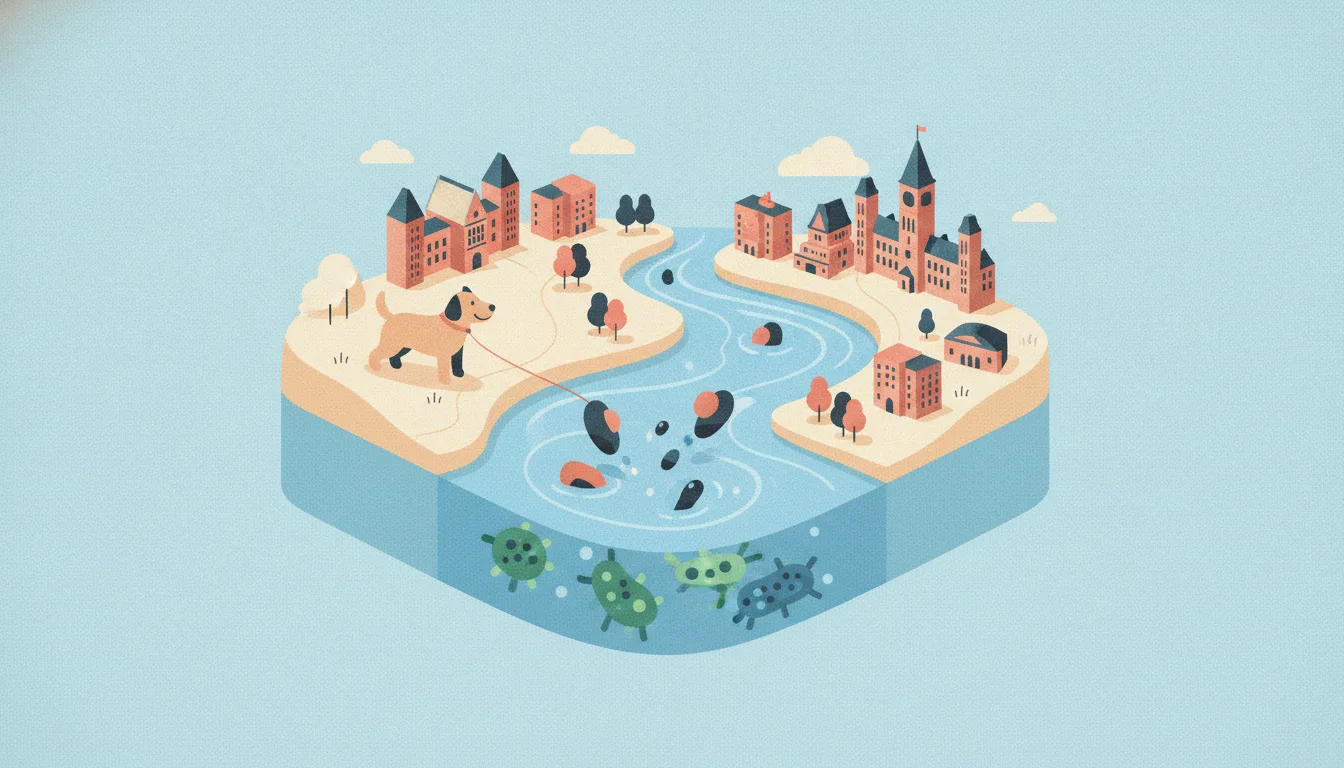
You're walking your dog along the Ottawa River pathway. Fido does his business. You're out of bags. It's just one little pile — what harm could it do? A lot more than you'd think. That one pea-sized gram carries an estimated 23 million fecal coliform bacteria (Popular Science) — more per gram than human waste. When the next rain comes, it doesn't disappear; it rides into storm drains, flows to our creeks and rivers, and ends up where your kids swim, where you paddle, and where the city draws its drinking water.
The real issue is the cumulative impact of thousands of owners each thinking "it's just one pile." When Ottawa's 100,000-plus dogs each leave one behind, the math gets ugly fast.
The Science: What's Actually in Dog Poop?
Dog waste isn't just an eyesore — it's a concentrated cocktail of bacteria, parasites, and nutrients. The rogues' gallery:
| Pathogen | Health risk | Persistence in environment |
|---|---|---|
| E. coli | GI illness; kidney failure in severe cases | Weeks to months in soil & water |
| Giardia | Diarrhea, dehydration, cramps | Months in cold water |
| Salmonella | Food-poisoning symptoms, fever | Months, sometimes longer, in soil |
| Roundworms (Toxocara) | Organ & vision damage in people | Eggs survive years in soil |
| Hookworms | Skin lesions, intestinal bleeding | Weeks in warm soil |
| Parvovirus | Often fatal in dogs; hardy | Months in the environment |
Roundworm eggs are especially stubborn, surviving in soil for years and posing a real risk to children (CDC).
The nutrient problem: dog waste is also loaded with nitrogen and phosphorus — the same nutrients as fertilizer, but delivered with a side of pathogens. Research on urban greenspaces has found that in dense areas, the nutrients from dog waste and urine can add up to a meaningful share of local nutrient loading. In waterways, those nutrients act as rocket fuel for algae.
How It Reaches Ottawa's Water
The stormwater highway. Most of Ottawa is on a separated sewer system: what goes down your toilet is treated at the Robert O. Pickard Environmental Centre, but what runs off lawns, sidewalks, parks, and paths flows into the nearest storm drain — and discharges untreated into the Ottawa River, Rideau River, or a tributary. When rain hits a pile of poop, it carries the bacteria and nutrients straight to that drain. No treatment. No filtration. No second chance.
The Ottawa River reality. The river supplies drinking water to roughly 900,000 customers, treated at the Britannia and Lemieux Island purification plants. They're world-class — but they can't prevent recreational water-quality problems at beaches. Ottawa Public Health monitors beaches like Britannia and Petrie Island each summer; when E. coli exceeds 200 per 100 mL, a swim advisory is posted, and dog waste is a documented contributor to those spikes.
From Nutrients to Toxic Blooms
When excess nitrogen and phosphorus reach slow, warm water — like the Rideau Canal system or Dow's Lake — they create perfect conditions for harmful algal blooms, especially cyanobacteria (blue-green algae). Here's the chain reaction:
The Rideau Canal saw notable blooms in recent years. No one pins a specific bloom on dog waste alone — waterfowl, farm runoff, and failing septics all contribute — but the City and conservation authorities consistently name pet waste as a source of the nutrient loading that feeds them. Every un-scooped pile near a waterway is a preventable contribution.
Proper Disposal That Actually Works
Good news: Ottawa's real rules are more flexible than the myths suggest. You have three solid options — the key is never leaving waste on the ground.
| Method | Best for | Notes |
|---|---|---|
| Bag & bin it | Walks & parks | Most convenient — always carry bags; use park or household garbage |
| Green bin | Home cleanups | City-approved: sealed leak-proof bag, up to 25% of the bin; diverts from landfill |
| Flush the waste | Home cleanups | Permitted by the City — flush the contents only, never the bag; gets treated |
A few myths worth busting: rain doesn't "wash it away" — it's the very thing that carries waste to the river. "It's natural in the woods" doesn't hold up either — a wolf goes once every few days, miles from water; your dog goes twice a day in a neighbourhood shared with a hundred others. And you don't need "compostable" bags — they only break down in industrial composting, not landfill or your yard, and for the green bin any sealed leak-proof bag is fine. Skip backyard composting unless you run a dedicated pet-waste system hot enough (65°C+) to kill pathogens.
Ottawa's Rules and How to Report
Ottawa's Animal Care and Control By-law requires every owner to immediately remove their dog's waste from public property — and from private property they don't own (your neighbour's lawn counts). "Immediately" means then and there, not "on the way home." Failing to do so is an offence; fines apply, and the City doesn't publish a single fixed amount on its general pages, so confirm the current figure via 3-1-1. Enforcement is handled by Ottawa By-law and Regulatory Services.
See someone not scooping? You can report it to 3-1-1 or through the City of Ottawa website (you can stay anonymous). Helpful details: exact location, a description of the dog and owner, and the date/time. Never confront anyone — just report and move on.
Frequently Asked Questions
Is dog poop worse than commercial fertilizer?
Both add nitrogen and phosphorus that feed algal blooms, but dog waste also carries bacteria and parasites that fertilizer doesn't. Neither belongs washing into waterways — but dog waste is the bigger public-health wildcard.
Can I compost dog poop in my backyard?
Only in a dedicated pet-waste system that consistently hits 65°C+ to kill pathogens — most backyard piles don't. Never use the result on edible plants. For most people, the green bin, garbage, or flushing is safer and simpler.
Does rain wash dog poop away?
No — that's a harmful myth. Rain disperses the bacteria and carries pollutants into storm drains and straight to the river. A pile left on a rainy day is actively polluting within hours.
What's the best way to dispose of dog poop in Ottawa?
Bag-and-bin on walks; at home, the green bin (sealed bag, up to 25% of the bin) or flushing the waste are the greenest routes. Never leave it on the ground or put it down a storm drain.
You Have the Power to Protect Ottawa's Water
Here's the honest truth: this is a problem every dog owner can help solve — no new technology or government program required, just picking up every time. Bags cost pennies; scooping takes seconds. Every pile you scoop is one that won't reach Britannia Beach or feed the next bloom.
And if you'd rather never think about it again, that's where we come in — consistent, scheduled scooping means the waste is gone before the next rain can move it.
Get a free quote from Scoop Dog or text/call 613-400-4040. New customers get $20 off the first month — no contracts, 100% satisfaction guarantee. 🐶
Sources
- Popular Science — Dog poop pollutes. Here's why you should pick it up.
- U.S. EPA — Nonpoint Source Pollution (pet waste)
- U.S. CDC — How Toxocariasis Spreads (roundworms & soil)
- City of Ottawa — Green Bin Program (pet waste rules)
- Ottawa Riverkeeper — local river health & water quality